Microneedling in Jacksonville.
Precise. Personalized.
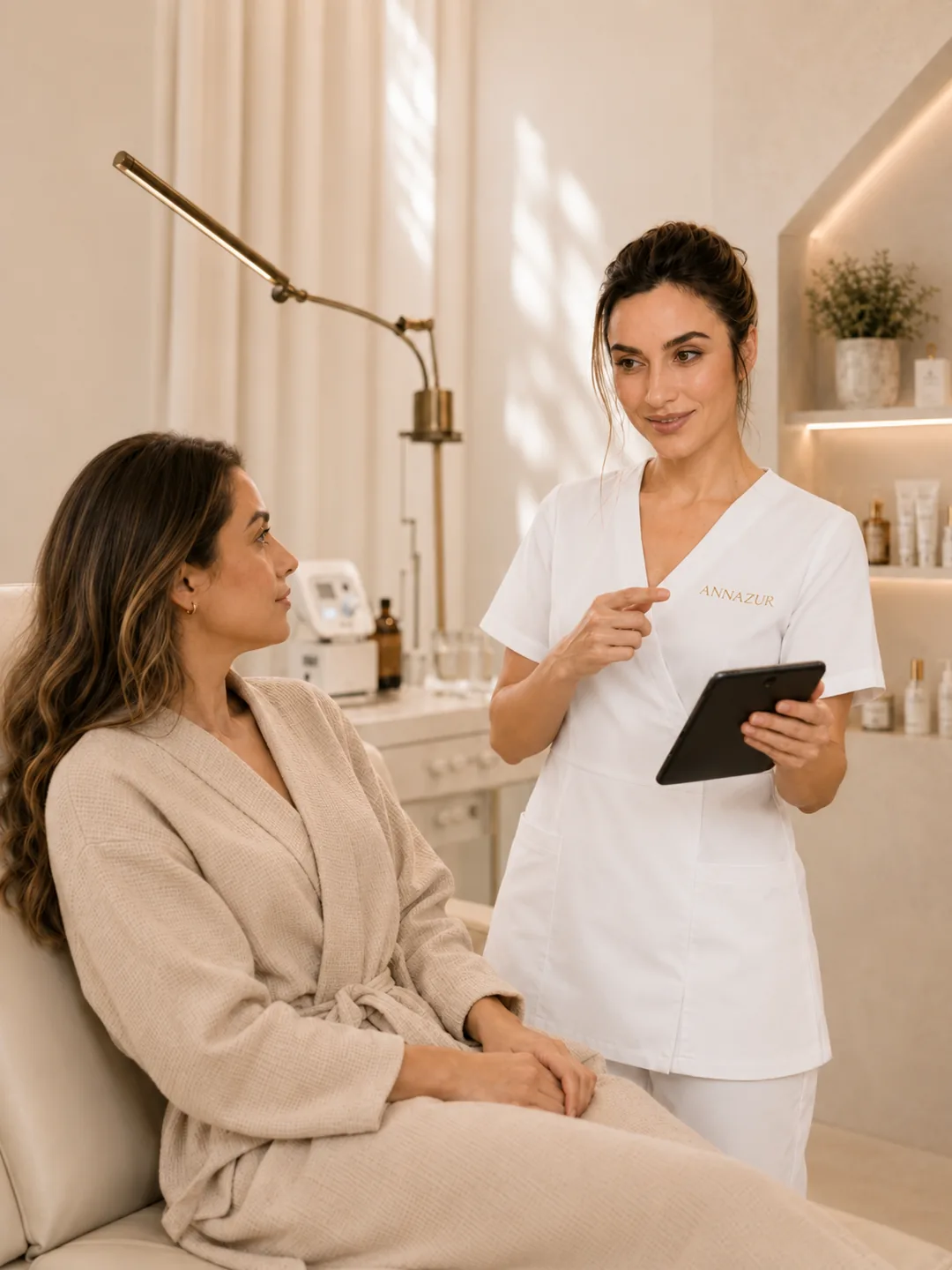
Professional microneedling for the appearance of smoother texture, refined pores and brighter tone. Your specialist reviews fit, process and aftercare before treatment.
COLLAGEN INDUCTION THERAPY
The science.
Simple.
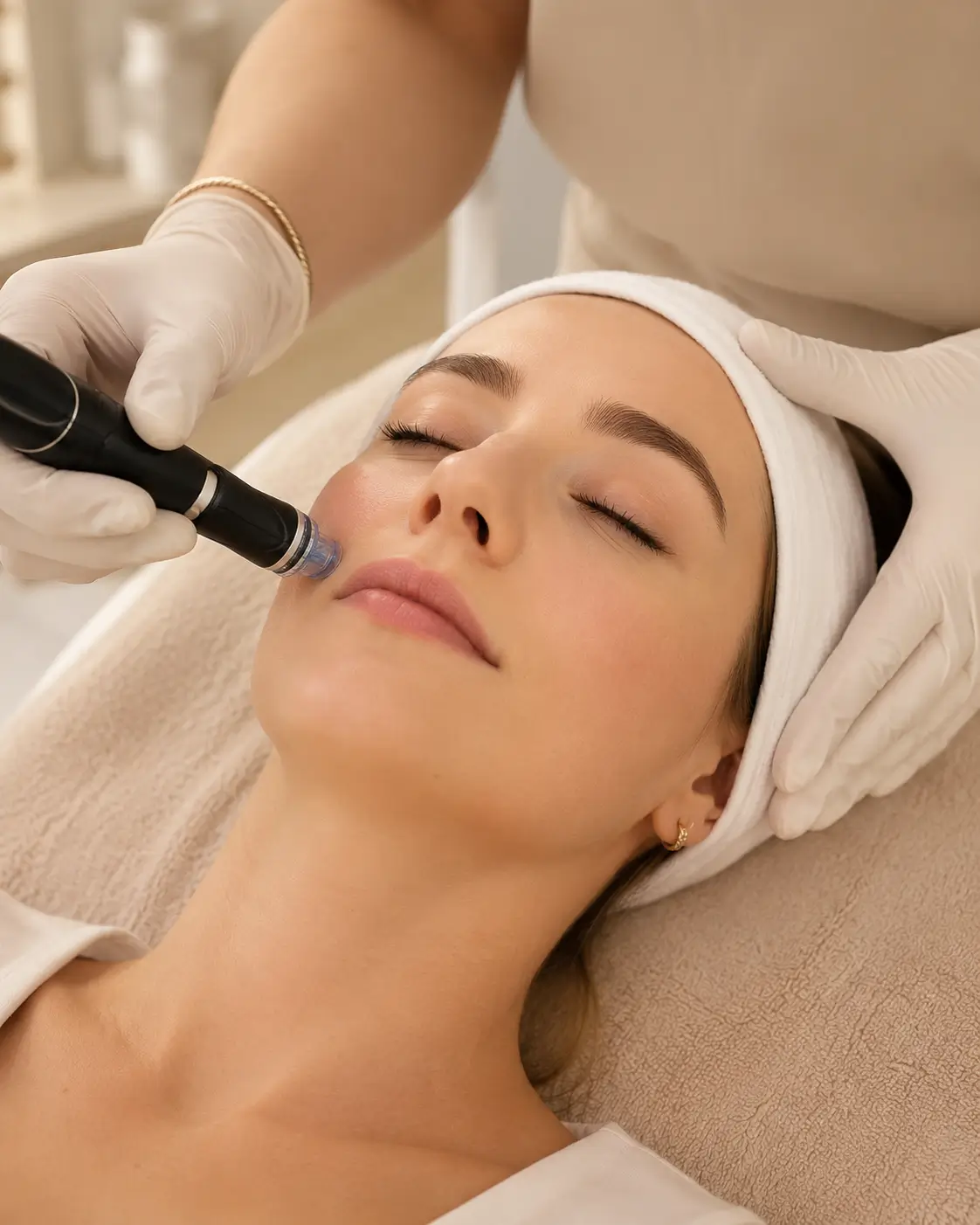
Microneedling uses ultra-fine sterile needles to create thousands of micro-channels in the skin. These invisible pathways signal the body to activate its natural repair process — producing fresh collagen and elastin from within.
This is not about injecting fillers, neurotoxins, or foreign substances. We give your skin a structured biological signal. Your skin rebuilds itself using its own resources. At ANNAZUR Organic SPA, we do not inject artificial substances. We create the precise stimulus your skin needs to renew itself naturally. The result is gradual, physiologic improvement — not an overnight transformation.
Collagen Induction Therapy (CIT)
The clinical name for microneedling. The visible improvement comes from your skin’s own rebuilding process — not from any substance we inject.
Motorized Derma Pen
A professional pen-style device creates precisely vertical micro-channels — not the dragging, angled trauma of home rollers. Depth is adjusted zone by zone in real time, from delicate areas to denser post-acne texture.
No heat. No ablation.
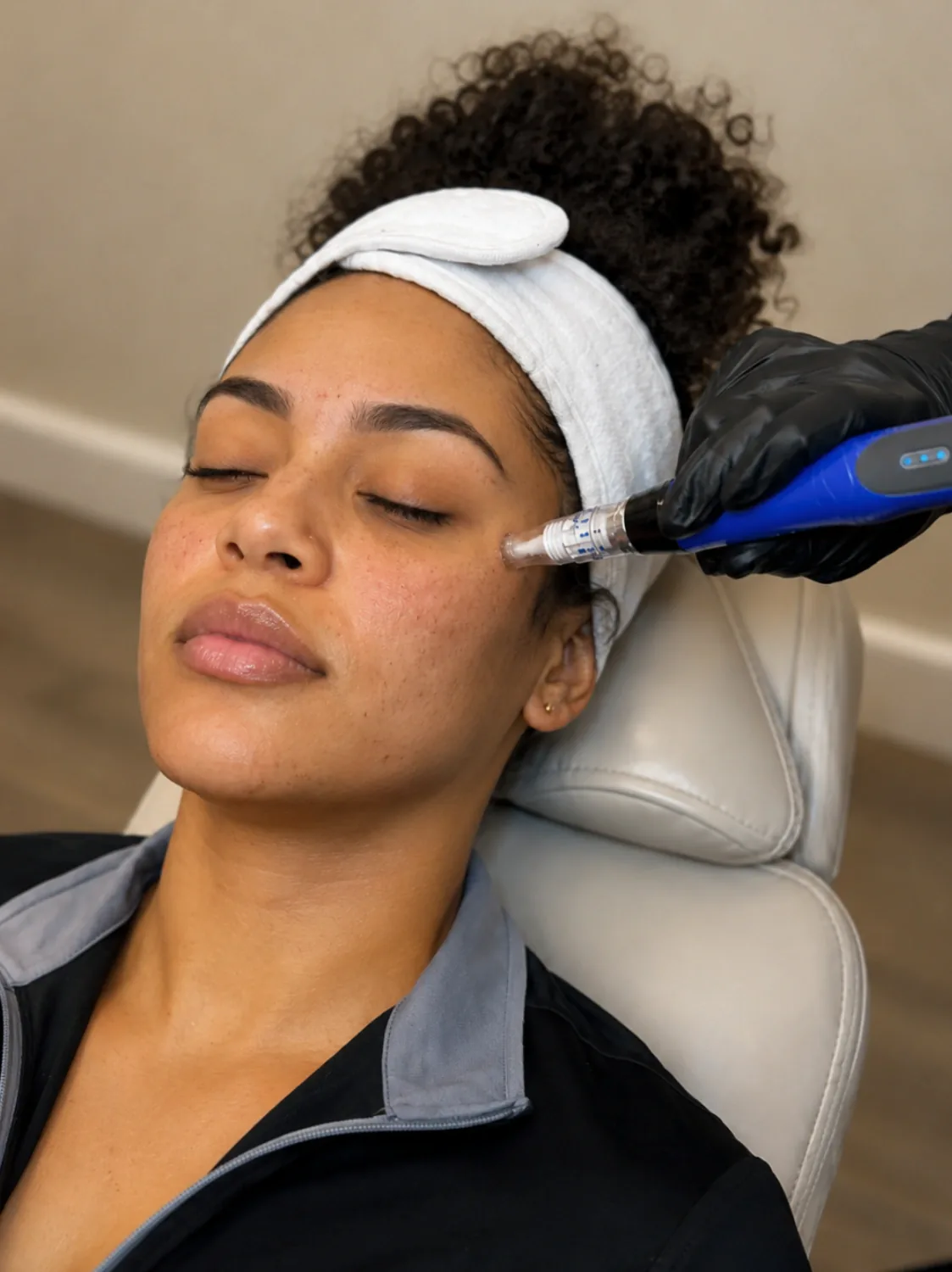
Unlike radiofrequency or laser, microneedling does not rely on thermal damage. With proper screening, conservative settings, and SPF discipline, it can be a suitable option to discuss for skin of color, with less downtime and no burned epidermis.
Collagen peaks at 21–28 days after treatment. This is why sessions are spaced 4–6 weeks apart — to let each biological cycle complete before the next stimulus.
In simple terms: controlled micro-channels are created, repair signaling begins, fibroblasts activate, and new collagen is synthesized in the dermis over time. That is why visible refinement builds gradually — not all at once.
SKIN MECHANISM
OVER TIME · controlled repair response
WHY CLIENTS CHOOSE IT
Real improvement.
Your own biology.
SKIN CONCERNS
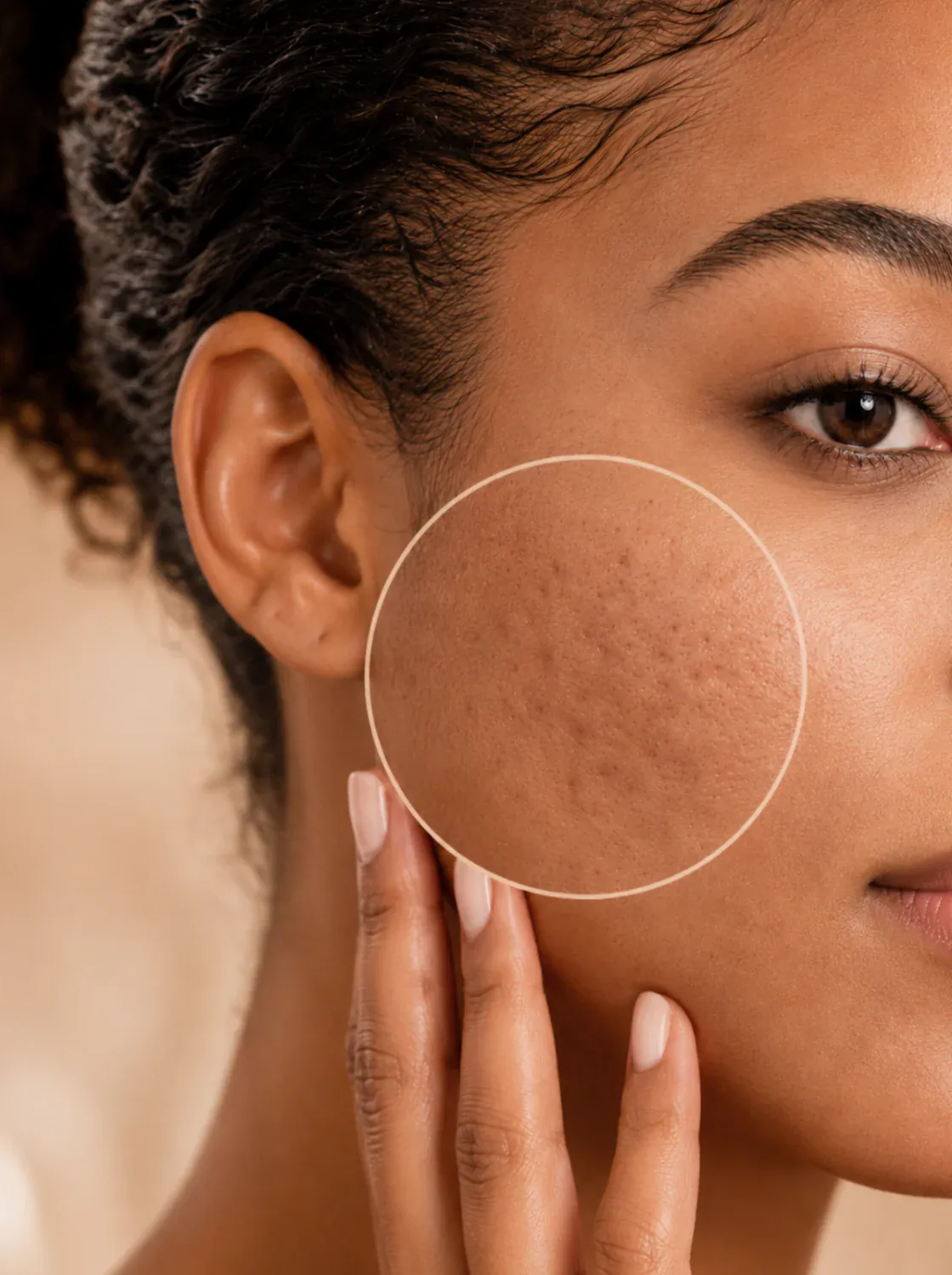
What microneedling may improve.
Different concerns respond differently. Acne marks, pores, fine lines, and dull tone improve at different speeds. Your plan should be built around your skin — not someone else’s before-and-after.
Post-Acne Texture & Scars
Supports remodeling of uneven surface tissue. May visually soften the look of shallow boxcar and rolling scars through cumulative collagen stimulation.
Deep ice-pick scars may need a longer course or a combination approach. Complete erasure should not be promised.
Enlarged Pores
Can improve pore tightness by supporting the firmness of surrounding tissue. Most noticeable on the nose, cheeks, and T-zone after a course.
Pore size is influenced by genetics and oil production. Consistent home care is needed for long-term refinement.
Fine Lines & Early Wrinkles
Helps the skin look denser and smoother as new collagen forms. Supports a fresher, firmer-looking appearance around the eyes, mouth, and forehead.
Does not replace injectables or lifting procedures for deep folds or significant skin laxity.
Dull Tone & Uneven Pigment
Accelerated cell turnover and improved microcirculation can leave the complexion looking noticeably more refreshed after recovery.
Melasma and darker skin tones require extra caution and conservative settings to avoid triggering post-inflammatory hyperpigmentation.
Mild Skin Laxity
May support a firmer, more resilient appearance through cumulative collagen stimulation. Best on early firmness loss rather than significant sagging.
Severe sagging or significant volume loss needs a different strategy, such as injectables or lifting procedures.
Skin Texture Overall
Helps refine the feel and look of the skin surface — less roughness, more smoothness under natural light and under makeup.
Results vary by skin condition, age, lifestyle, home care, and number of sessions. Realistic expectations are discussed at consultation.
The most important distinction
Microneedling improves the appearance of skin quality. It does not diagnose, treat, or cure a medical skin disease. If your concern appears medical, rapidly changing, or infectious, the right first step is a medical provider — not an esthetic treatment.
YOUR SESSION
The process.
Step by step.
Every visit begins with skin assessment — not the device. We read your barrier, check for contraindications, and adjust the entire session to your skin on that day.
Skin Assessment & Consultation
Your specialist examines texture, sensitivity, active inflammation, pigmentation risk, and recent treatments. This determines whether microneedling is appropriate today — and exactly what the session will look like.
Double Cleanse & Disinfection
Makeup, oil, sunscreen, and surface debris are fully removed. The treatment area is then prepared according to strict sanitization protocol. Microneedling opens temporary micro-channels — cleanliness is non-negotiable.
Skin Prep & Sterile Setup
Your skin is carefully prepared for treatment, and a new sterile cartridge is opened before every session. We confirm the treatment area, select the appropriate depth settings, and make sure everything is ready before microneedling begins.
Precision Microneedling
Depth is adjusted zone by zone: 0.25–2.0 mm depending on skin thickness, the concern being treated, and your real-time skin response. Thin areas around the eyes get fundamentally different settings than dense post-acne zones on the cheeks.
Recovery Serum & SPF Finish
After microneedling, a calming recovery serum is applied to support the skin barrier. The session finishes with a restorative barrier cream and broad-spectrum mineral SPF. You leave with a written aftercare guide for the first 48–72 hours.
Optional cooling mask is available as a paid add-on and is included with Microneedling Deluxe.
SESSION AT A GLANCE
Important: Your skin is not the same thickness everywhere. Cheeks, forehead, nose, upper lip, neck, and the delicate under-eye area all require different depths and technique. No responsible provider should needle the whole face at one fixed setting.
Ruzanna’s signature approach: adjusting depth and pressure in real time based on tissue feedback during the session — not before it. This is what separates a precise treatment from a template.
PROFESSIONAL VS AT-HOME
The difference is technique.
A home roller and a professional pen-style device are not the same tool. The difference in needle movement, depth control, and sterility directly affects results — and risk.
The cheapest tool can become expensive if it causes irritation, infection, broken capillaries, or pigment changes that require professional correction later. Safety starts with judgment — not just a device.
| Factor | Professional at ANNAZUR ✓ | At-Home Dermaroller |
|---|---|---|
| Needle movement | ✓ Vertical, controlled entry — cleaner micro-channels, minimal tissue drag | △ Rolling motion drags through skin, creating angled and wider trauma |
| Depth control | ✓ Adjusted by zone, concern, and skin thickness (0.25–2.0 mm) | △ Fixed depth across the entire face — no customization |
| Sterility | ✓ Single-use sealed cartridge opened in front of you, discarded after | ✗ Reused needles — biological residue cannot be fully removed at home |
| Skin screening | ✓ Specialist checks for contraindications, barrier damage, sensitivity, pigment risk | ✗ Most users treat based on guesswork or online advice |
| Depth of effect | ✓ Reaches the dermis — true collagen induction and structural remodeling | △ Typically ≤0.5 mm — superficial epidermal only, no real collagen change |
| Risk profile | ✓ Near-zero when performed by a licensed, trained professional | ✗ Elevated risk: hyperpigmentation, broken capillaries, infection |
| Aftercare plan | ✓ Matched to your depth, skin response, and lifestyle | ✗ Often based on general online advice — frequently too aggressive |
The cheapest tool can become expensive if it causes irritation, infection, broken capillaries, or pigment changes that require professional correction later. Safety starts with judgment — not just a device.
TREATMENT PLANNING
How many sessions.
Why spacing matters.
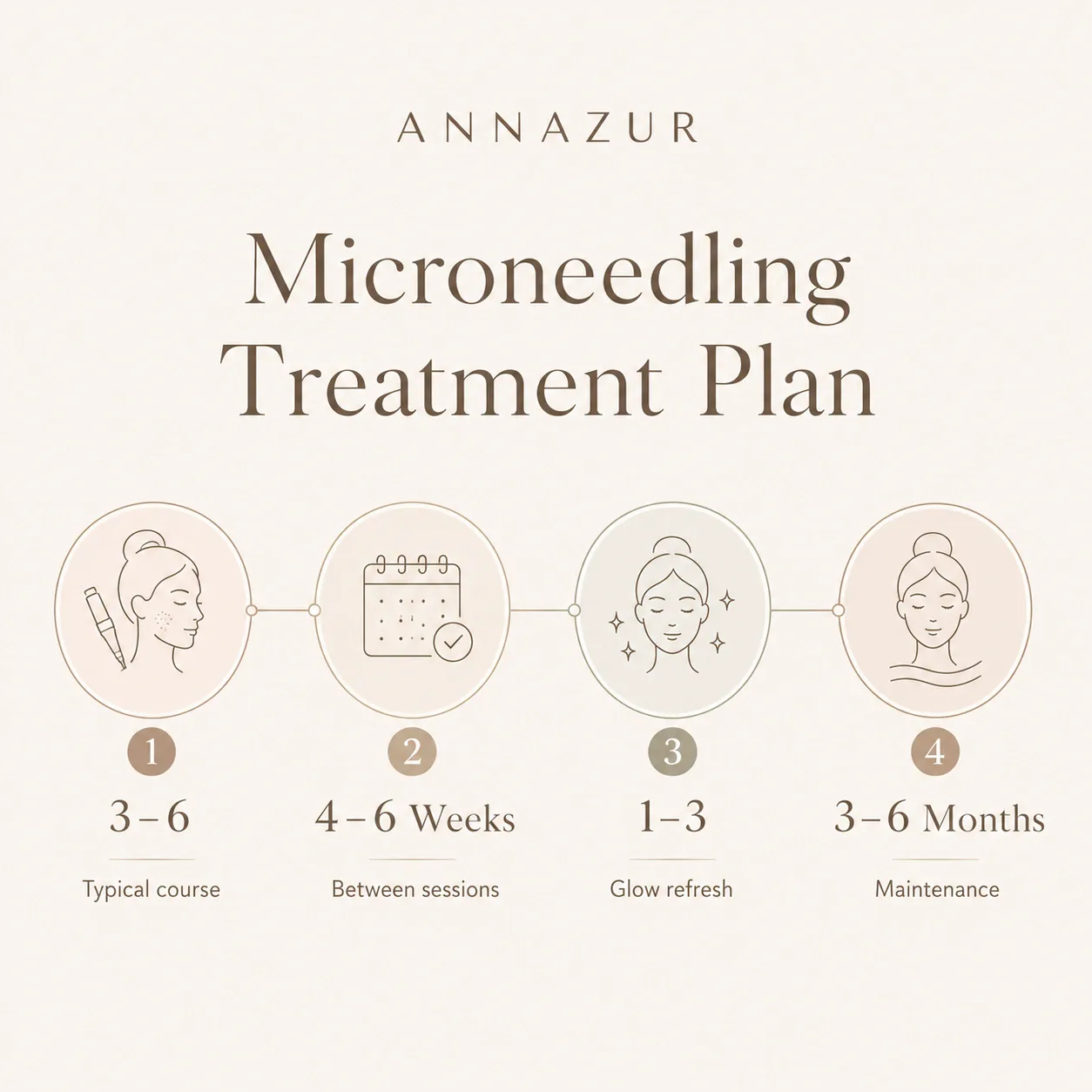
Collagen remodeling is biological — it operates on a schedule. Sessions too close together irritate the barrier instead of improving it.
Sessions in a series
A standard plan for texture, pores, and post-acne marks. Spaced 4–6 weeks apart to allow the full collagen cycle to complete.
The interval
Collagen synthesis peaks around day 21–28. This interval is physiologically critical — not a scheduling preference.
Tone refresh
Clients seeking a general glow boost or early texture refinement often see meaningful improvement within a shorter plan.
Long-term care
After the initial course, maintenance sessions every 3–6 months preserve firmness, tone, and the long-term investment in your skin.
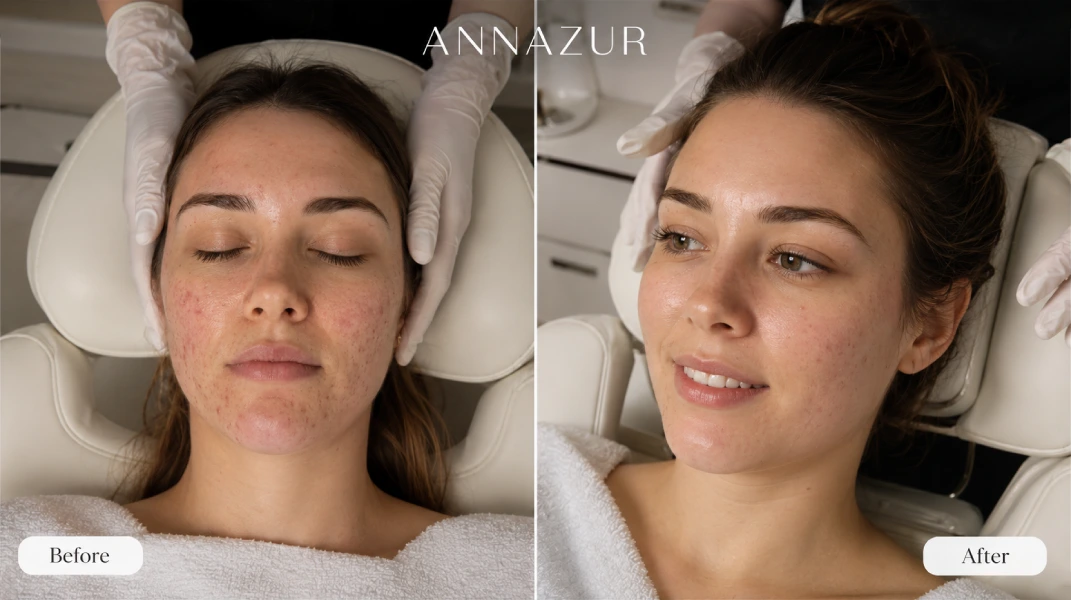
A first-session glow is not the same as scar remodeling. Texture change is cumulative. Your plan should be based on your skin, your goals, and your real response — not someone else’s result photo.
BEFORE YOUR SESSION
Preparation.
Protect the barrier first.
Good preparation reduces irritation, improves comfort, and gives your specialist more predictable skin to work with. The goal in the week before treatment: keep your skin calm, hydrated, and uninjured.
| Timing | What to Do | Why It Matters |
|---|---|---|
| 7 days before | Avoid prolonged sun exposure, tanning beds, and strong exfoliating treatments | UV exposure increases sensitivity and post-treatment pigment risk |
| 5–7 days before | Pause retinoids and strong acids if your specialist recommends it | Helps protect the barrier from over-irritation going into the session |
| 3 days before | Avoid waxing, laser hair removal, or harsh facials in the same area | Stacking trauma makes skin reactive and can affect the treatment plan |
| 24 hours before | Avoid alcohol and intense exercise if you flush easily | Reduces excess redness, sensitivity, and capillary fragility |
| Day of treatment | Arrive without heavy makeup if possible | Clean prep is easier and more accurate for skin assessment |
| Consultation | Share full medication list, supplement use, recent procedures, pregnancy/nursing status | These details can change whether treatment is appropriate that day |
Don’t hide skin history to “qualify” for treatment
Arriving with sunburn, active peeling, or a stripped barrier turns a useful treatment into unnecessary irritation. A delayed session is always better than a complication. Good providers protect you even when it means rescheduling.
AFTER YOUR SESSION
Recovery.
72 hours. What to expect.
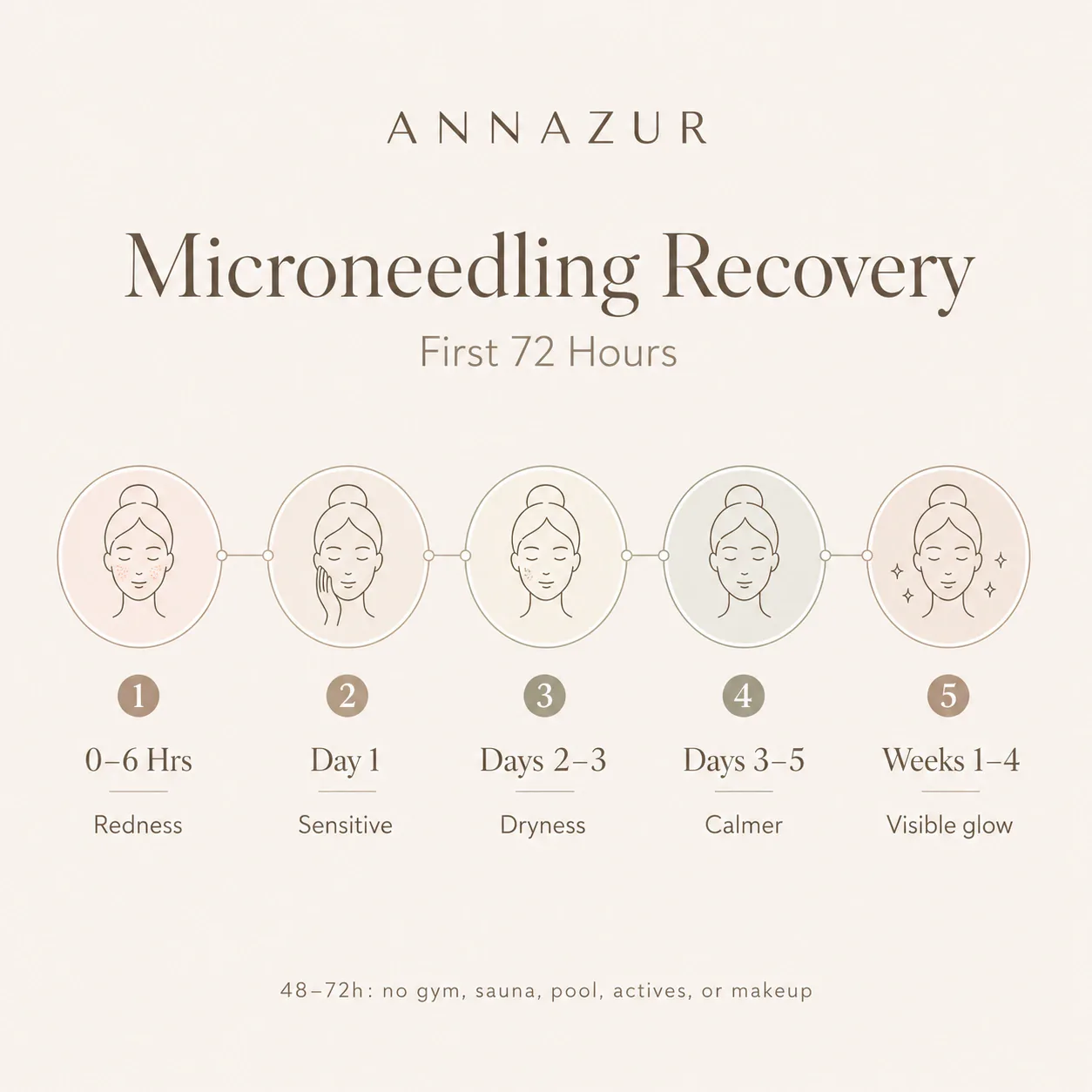
Microneedling has minimal social downtime — but your skin needs mindful care immediately after. The first 48–72 hours matter for both comfort and the quality of your final result.
Redness & Warmth
Skin looks and feels like a mild sunburn. Normal response. Keep skin clean and do not touch with unwashed hands.
Flush & Sensitivity
Redness usually fades significantly by morning. Use only specialist-approved products. No makeup, gym, sauna, or pool.
Dryness & Flaking
Light “sandpaper” texture — normal shedding of dead cells. Hydrate generously. Do not pick, scrub, or exfoliate.
Calming Down
Skin feels and looks noticeably calmer. Continue mineral SPF daily. Avoid retinoids and strong actives until cleared.
Visible Improvement
Collagen rebuilding accelerates. Freshness and smoothness gradually increase. SPF is part of protecting the result.
48–72 hour restrictions: Avoid strenuous exercise, saunas, steam rooms, chlorinated pools, hot yoga, strong active serums (retinoids, acids), and makeup applied with brushes.
Jacksonville sun note: freshly stimulated skin is more vulnerable to UV damage. Mineral SPF is not optional after microneedling — it is part of protecting your result. Schedule strategically around beach trips.
SAFETY FIRST
When to wait.
What we screen for.
Microneedling is minimally invasive, but it is still invasive. We take contraindications seriously — and we will tell you honestly when your skin needs a different plan first.
Active inflammatory acne
Needling over pustular breakouts can spread irritation and bacteria. Stabilize the skin first.
Active herpes simplex (cold sore)
Treatment may worsen or spread the flare. Prophylactic antiviral therapy may be required — coordinate with your physician.
Open wounds, cuts, or sunburn
The skin barrier is already compromised. Microneedling requires intact skin to perform safely.
Keloid or hypertrophic scar tendency
Wound healing response may be unpredictable. Disclose this history before booking — it affects the entire treatment plan.
Pregnancy or nursing
Due to limited safety data, microneedling is postponed as a precaution during pregnancy or nursing.
Recent isotretinoin (Accutane)
Typically requires a 6–12 month clearance window. Prescribing physician clearance is required before proceeding.
Fresh dermal fillers in the zone
We typically wait 2–4 weeks for filler integration to stabilize. Increased blood flow can alter intended placement.
Blood thinners & certain medications
Some medications increase bleeding risk or photosensitivity. Your full medication list must be disclosed at consultation.
This is a screening guide, not a diagnostic tool. Your specialist makes the final decision. If your condition is unclear, we may request medical clearance before proceeding. Honesty protects your result.
INVESTMENT
Transparent pricing.
No surprises.
Standard microneedling sessions include skin assessment, cleansing, sterile procedure, recovery serum, mineral SPF, and aftercare guidance. A cooling mask is available as a paid add-on and is included only with Microneedling Deluxe.
Professional Session
Member / first-time price · regular $280
- Skin assessment before treatment
- Double cleanse & disinfection
- Single-use sterile cartridge
- Zone-adjusted precision needling
- Recovery serum + mineral SPF finish
- Written aftercare instructions
Ruzanna's Signature Session
Member / first-time price · regular $349
- Everything in Professional Session
- Founder-level expertise & precision
- Real-time tissue reading technique
- Zone-by-zone depth micro-adjustment
- Advanced personalization protocol
- Extended aftercare consultation
Microneedling Deluxe
Member / first-time price · regular $500
- Full Professional Session protocol
- Reduces lines, wrinkles & scars
- Improves visible skin texture and tone
- Alginate seaweed + C‑Vit mask included
- Helps moisturize and reduce redness
- Accelerates post-treatment recovery
No hidden fees. The exact cost for your personalized plan — including any recommended complementary treatments like Dermaplaning or O2 Lift Facial — is discussed and confirmed before any treatment begins.
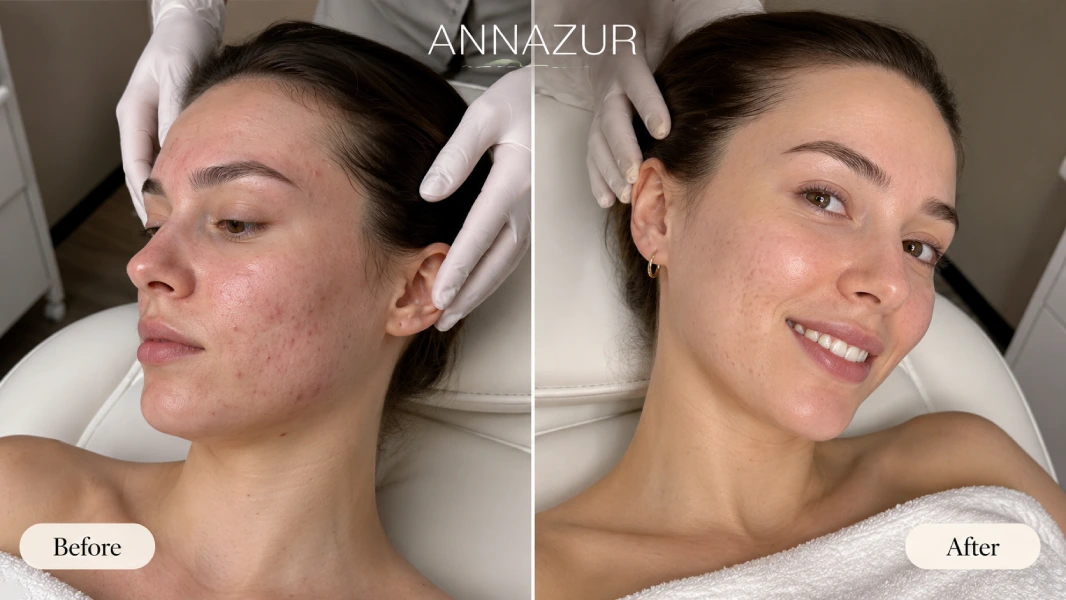
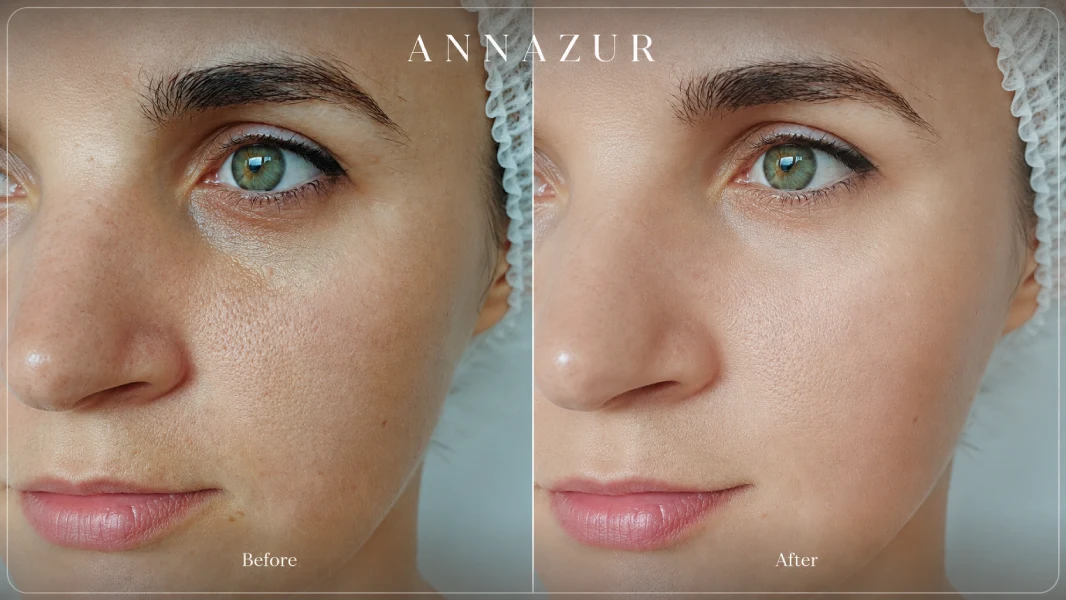
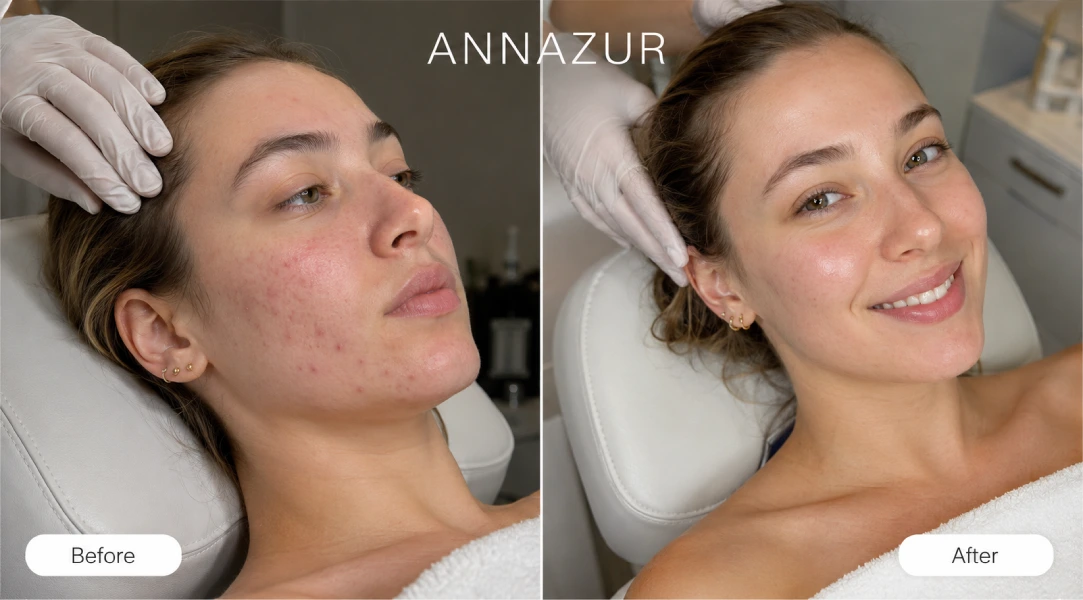
Before & After Results. Visible Skin Improvements.
WHY ANNAZUR ORGANIC SPA
Expertise.
Precision. Care.
We are built for clients who want visible skin improvement without a cold clinical experience or an aggressive approach. The protocol combines careful screening, sterile technique, and calm organic recovery support.
Licensed & inspected
Operating under Florida DOH and DBPR oversight. Every esthetician holds an active, verifiable license. We exceed standard hygiene protocols — sterile cartridge opened in front of you, every visit.
Ruzanna’s signature technique
Reading the skin in real time during the session — not before it. Areas with thinner, more reactive skin are treated differently from thick post-acne zones. This prevents the common mistake of treating the entire face as one flat surface.
Ethical recommendations
If microneedling is not right for your skin today, we tell you. We have a full menu of preparatory and alternative treatments — and we would rather recommend those than perform something that won’t serve you.
Two Jacksonville locations
Salisbury and Hodges — serving Jacksonville clients with the same standard of care at each location.

We do not perform a 15-minute, 0.5 mm all-over session. We take the time necessary to work on your specific concerns. If your skin needs a gentler approach on the cheeks but deeper work on jawline scars — that is exactly what we do.
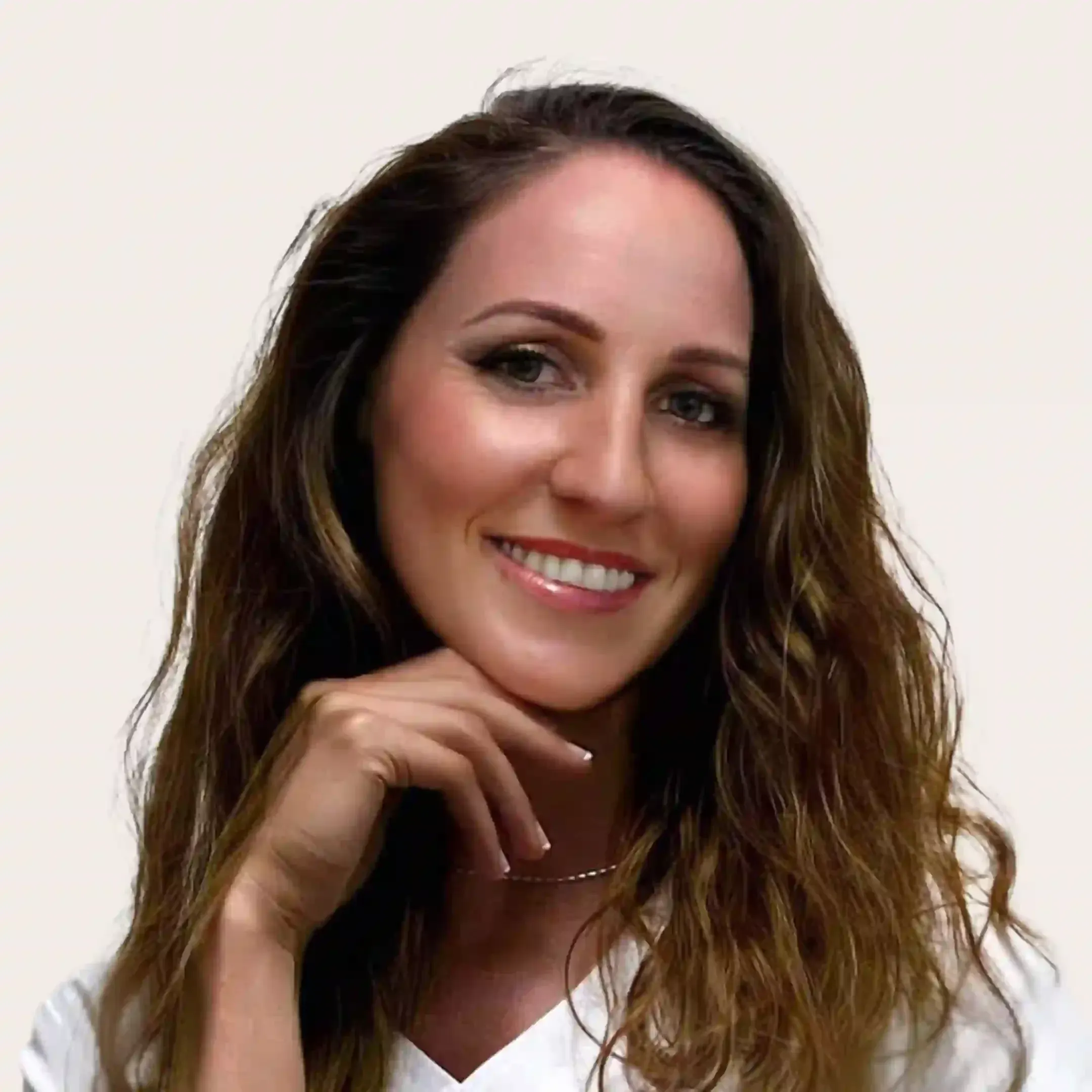
Ruzanna · Founder, ANNAZUR Organic SPA
EVERY SESSION INCLUDES
Before you book.
What to know.
These are the practical questions clients ask before committing to a course — details not covered elsewhere on this page.
Will I bleed during the session?
In areas where deeper penetration is required — like scarred tissue — you may notice tiny “dew-like” blood spots. This is a normal clinical endpoint signaling that the needles have reached the dermis where true collagen remodeling occurs. For lighter texture treatments, there is little to no visible bleeding. Your specialist continuously cleanses the skin throughout.
Can I combine microneedling with Botox or fillers?
Yes, but with strict timing. Wait at least 2 weeks after Botox injections before microneedling near the treated area. After dermal fillers, we typically wait 2–4 weeks to allow integration and avoid altering the intended placement. Always follow your injector’s instructions first — they take priority.
Is microneedling safe for darker skin tones?
Microneedling is often chosen specifically because it does not rely on heat the way laser or radiofrequency procedures do. That said, Fitzpatrick IV–VI skin tones can be more prone to post-inflammatory hyperpigmentation if the skin is overtreated or exposed to sun too soon after. We use conservative settings, strict anti-inflammatory aftercare, and specialized atraumatic protocols for skin of color. Daily mineral SPF during recovery is essential.
Can microneedling be done under the eyes?
With extreme caution, yes. The under-eye skin is the thinnest on the face, so we use shallow depths (typically ≤0.5 mm) and a very conservative approach. It may help with fine lines in carefully selected candidates. Microneedling cannot address under-eye bags caused by fat pads, fluid retention, or anatomy — those require a different strategy. Never attempt the under-eye area at home.
Do I need to take time off work?
Most clients schedule on a Friday afternoon. By Monday morning, the redness has typically faded to a soft pink that can be covered with light mineral powder if needed. There is usually no need for sick leave. If your work involves outdoor UV exposure or physical activity that causes heavy sweating, discuss the timing with your specialist beforehand.
What is the “orange peel” texture I’ve heard about?
Worsened or “orange peel” texture after microneedling is almost always linked to protocol errors: treating too frequently, using overly aggressive depth, poor technique, an unstable barrier going in, or bad aftercare. Professional screening, correct spacing between sessions, and barrier-supportive recovery reduce these risks significantly. The safest approach is measured — not maximal.
Can microneedling help with stretch marks?
Microneedling can be applied to body areas — stomach, thighs, décolletage — to improve texture and mild surface irregularities. Mature, silver-toned stretch marks respond better than fresh red ones, which require a completely different protocol. Body skin is thicker and usually requires more sessions than facial work. A separate consultation is needed to assess candidacy and create a realistic plan.
How is microneedling different from laser resurfacing?
Laser resurfacing (ablative) removes layers of skin using heat and requires significant downtime — often weeks. Microneedling creates micro-channels mechanically, without destroying the epidermis, and works from within by stimulating collagen. Recovery is generally 24–48 hours versus 1–3 weeks for ablative lasers. Microneedling also carries lower pigmentation risk for darker skin tones because it does not generate heat.
Am I pressured to buy a package at the consultation?
No. A responsible provider should not push you into a package before seeing how your skin responds. A series is often recommended for texture and post-acne marks, but the plan should reflect your goals, tolerance, and first-session response. We discuss realistic options — and you decide.
What does the “sandpaper” feeling on day 2–3 mean?
Completely normal. It is microscopic crusting and dead skin cells preparing to shed as part of the natural turnover cycle triggered by the treatment. Do not exfoliate, scrub, or pick — apply your prescribed barrier cream and they will disappear on their own within a day or two. Rushing this process can cause unnecessary irritation.
Can I schedule before a big event or photoshoot?
Do not schedule microneedling right before an important event, photoshoot, or beach trip. Plan your session at least 10–14 days ahead of anything requiring you to look your best. For weddings, major appearances, or travel, discuss the timeline with your specialist and plan the course accordingly — not around a deadline.
Why can’t I use retinol right after microneedling?
After microneedling, the micro-channels are temporarily open and the skin is more permeable. Retinoids penetrate too deeply in this state, causing severe irritation, chemical-like burns, and post-inflammatory pigmentation. The same applies to strong acids. Your specialist will tell you exactly when it is safe to restart your actives — typically 5–7 days post-treatment, depending on your skin’s recovery.
What our clients say about microneedling

It is the best facial spa studio in Jacksonville! The owner is very nice, their estheticians are knowledgeable and professional! They use high quality products that make my skin feel amazing. The facility is clean, atmosphere is relaxing. Owners do take their

Just a great facial and dermaplanning. 10/10 recommend as she was very professional, sweet, and informative regarding my skin.

Had an acne treatment and facial with Marina. The service was as amazing and helped me a lot making my face much cleaner. Definitely recommend this spa.

I had a facial with Ruzanna and an aromatherapy session for the first time. I am really glad I went. My skin needed all the attention. Ruzanna knows her stuff! I highly recommend Annazur!

Ruzanna is literally the best. She is kind, friendly and knows her stuff. I have acne prone skin and with her help i have seen SIGNIFICANT improvement. Get the membership, it is worth it! My husband and i will only go here to get our facials. Best facials in Jax!

Excellent acne facial, everyone was welcoming and accommodating, thank you!

Marina was absolutely wonderful and I got the best facial and head massage ever!

Went to Annazur today for an acne facial with Aliz and it was absolutely amazing. Will be back!

My first time getting a facial and it was amazing! Very relaxing and I can see the difference!! Definitely recommend
START HERE
Consultation first.
Treatment second.
The best microneedling result starts before the device touches your skin. Your specialist will evaluate your barrier, assess your goals, screen for contraindications, and build a realistic plan — not a generic protocol.
No pressure. If microneedling isn't right for you today, we'll tell you — and recommend what is.